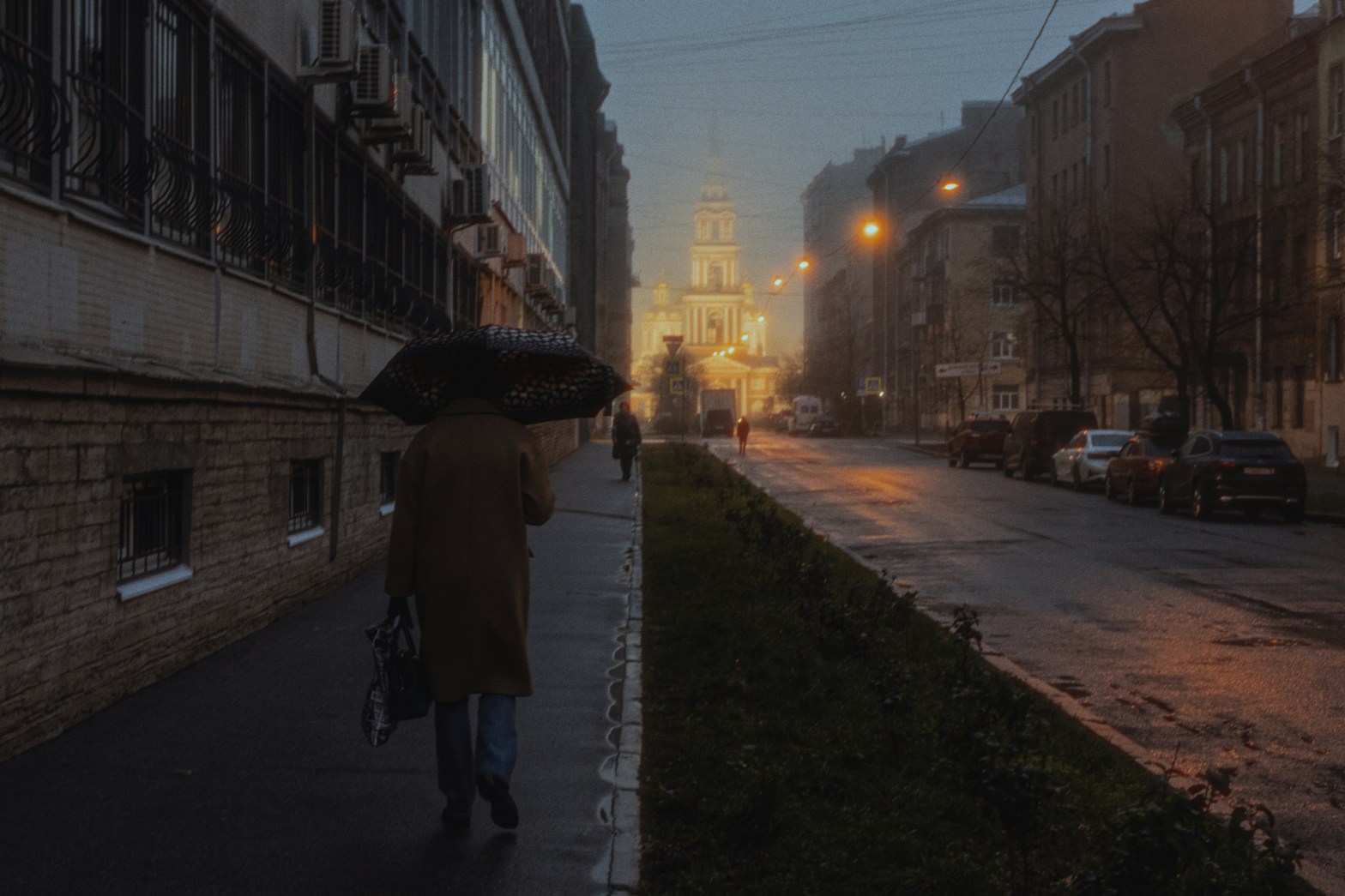
Sasha had frizzy platinum blonde hair, beautiful green eyes, a Slavic demeanour that left her with an aura of stubborn self-reliance, a coldness that put many first-timers off. There was a romance about her, though, and her dreary Soviet town, her fuzzy green 80s sweaters, the commie-blocks and the Brutalist architecture of her native Volgograd. It was a cold day, rainy and blue. And like the day, Sasha was cold and sort of miserable at first, like she gave you that sense about her, but her romance shone through when you really got to know her — her passion, her romance, her sweetness was almost off-putting, jarring, eyebrow-raising, like she wasn’t quite who you thought she was when you first met her.
She took you to The Motherland Calls statue, that grand piece of Soviet realist architecture, a wonder atop a hill, one arm holding a sword in a call to battle. We don’t create like that anymore, with such brilliance and audacity, like we used to, with the self-determination of a modernist people, oriented on something dangerously, radically new. New ideas, new projects, statues, and buildings, and a society that was poised towards greatness, unconditional greatness, the pursuit of something more. At certain hours of a sultry winter’s day, as old, musty blood dripped into the former Stalingrad’s black permafrosted soil, mother Russia would hold the setting orange sun in her hands, literally holding that promise in hands tattered and calloused. Sasha knew it wasn’t actually like this, all that romance. The Soviet Union wasn’t actually like that. A lot less commie-block romanticisation and musings, a lot less of that cold but inspiring literature, none of that optimism of 90s Russia.
Mother shot shells into the stanchion of democracy. Just like the idea of you and her, it was romance, not truth. But is it so bad to live in an idea? Is it so bad to live in a dream that at least looked to the future with the idealism of rockets in space, the romance of grand statues and concrete squares so ubiquitous they dominated the landscape, so audacious as the bounds of her love, her sweetness, everything that she is?
She kissed you softly, beneath the statue, that blue evening Slavic light. And as night fell the rain changed to snow, and you two sat in perfect verisimilitude with the stars, in a steel Soviet playground as the snow accumulated beneath your feet. And she kissed you some more, with such elegance you admired, such stoicism. She was so well put together. Private and shielded. Holding such tormented, ecstatic wonder.
And then you wondered if New York was all that different from her(e), all that Romance and Passion and Dreams, at once, robbed of that city. By some divine weight it was as if that mass of love were channelled at once into Sasha’s eyes. She was the most beautiful thing you ever heard.
Whence came the cessation of more, more, more. Her platinum blonde hair fluttered next to you, and you looked at her, enchanted. Beneath thy riches, snow-snuffed poppies blow.
Snowflakes gathered on the strands of her frizzy hair, like silvery crystals scattered atop golden Western prairie grass. Her Slavic accent whispered sweet nothings in your ear. And her soft white skin, her freckles, her green frizzy sweater, her brighter green eyes. For a moment the snow was golden and the heavens opened up at once to lift you closer to the glory of God. The Motherland, the Dream, the Girl.
That night, some republics east of this battered land, in the Kazakh provinces, the shell of the Buran materialised. That great steel mass coalesced into everything it was meant to be, everything it never was. And from the dilapidated visage of the Baikonur Cosmodrome man broke again into space, defied nature and gravity and revolution and the LORD, to take his place amidst the sublime company of the stars. Blasting off in a fiery inferno, soaring through the atmosphere, daring the sky to hold it back, countering all that mass of air and the gravity that tethered it to the ground, that incredible monument to human engineering pushing, defiantly, stubbornly, idealistically, naively, hopefully pushing against the hand of God.
There it drifted weightlessly through the upper atmosphere, above a Socialist world, or not, and a global Revolution, or not — and that testament to the sheer possibility of man stood humbled before the eyes of the LORD God. Audaciously, it pushed upward and upward until there was nowhere farther up to go. And the space was enveloping, all-encompassing. It wraps itself around you. It’s not a hug, not an embrace. It’s a nuclear bomb. It fries your skin from the inside out, surrounds you in the immensity of its apocalyptic plume, and one can’t help but admire the spectacle, can’t help but be struck by the sheer awe of what we were able and willing to do to rob ourselves of life wholeheartedly, viscerally, totally. To think that we are capable of such destruction, and simultaneously, capable of such life, should we choose it, should we hope that we use our ability to create above and beyond ourselves, to create on a precipice of wonder in the large and the small, in totality and specificity, in freedom and brotherhood — it’s all too much: too beautiful, too fast, too violent, too strange.
Such were the bounds of her wonder.
She could never be perfect, never quite the same as before. But the Romance is all that really mattered, just you and her beneath soft Soviet snow, falling, falling, faking, faking, falling.
She said beautiful things to you that you could never remember. Then she ran off into the mass of Volgograd’s buildings, her late-night crowd.
And at once you were alone in the Soviet Union, at the end of history. She never bid you goodbye.
 line of best fit