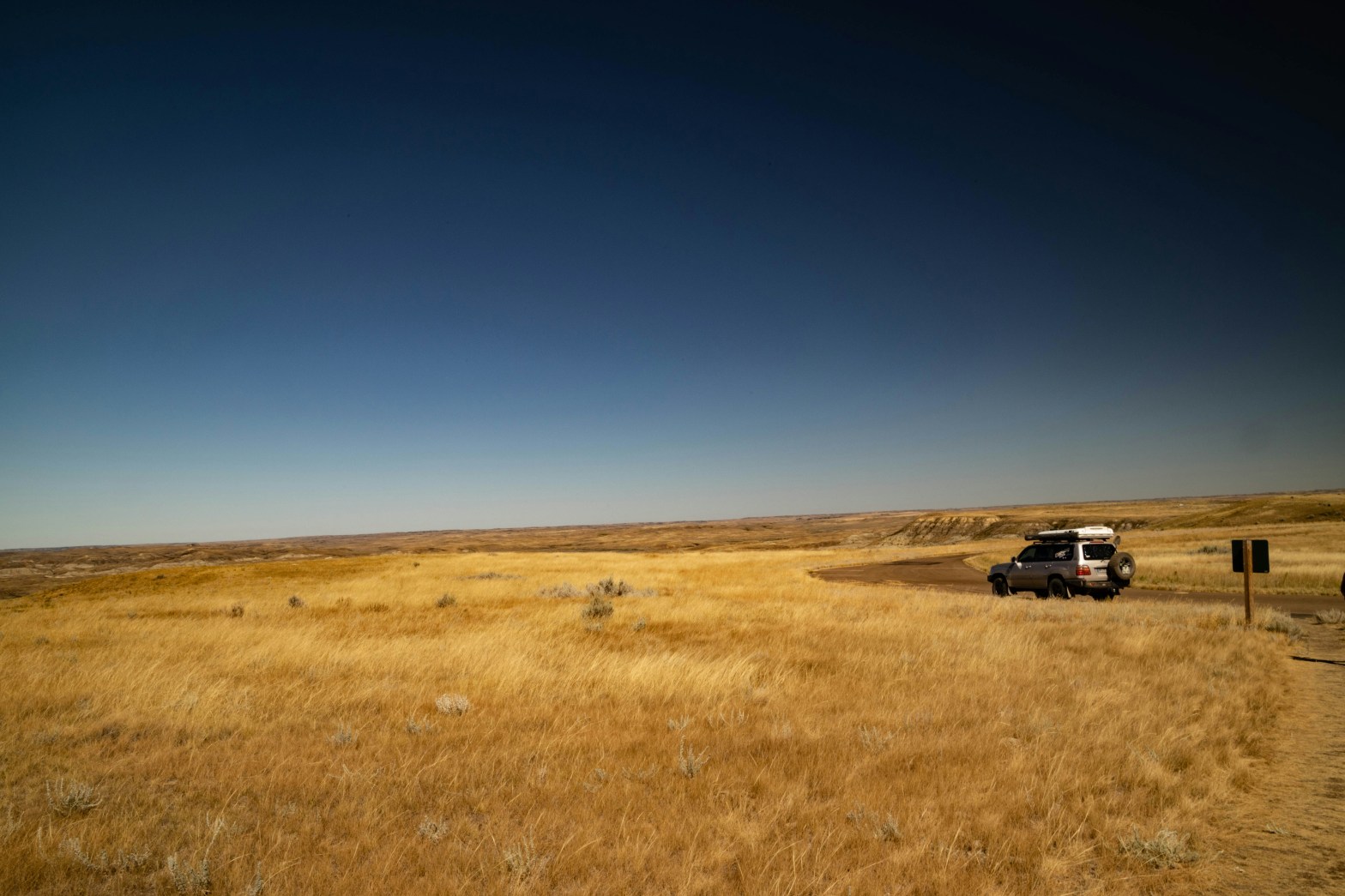
In the southwest corner of Saskatchewan, there exists a rural municipality known to Statistics Canada as Reno No. 51. It lies six hours south of my hometown, Calgary, which, in the vast expanse of the Canadian Prairies, is but a short jog away. Neither is it particularly far away from the various population centres in northern Montana and southern Alberta. It is strange, then, to conceive of the fact that this region, which has a comparable land area to the state of Massachusetts, is home to a mere three hundred people. Indeed, Reno No. 51 is disconcertingly empty.
The only road charting this endless golden prairie is a gravel highway known as the Red Coat Trail. A careful study of road atlases suggests that the road connects a series of villages, with names like Consul, Govenlock, Vidora, and Olga. Yet upon visiting the region, one finds that those villages seem to exist solely to populate federal government census data, because these long-abandoned towns have been decimated by urbanisation and swallowed by the prairie, leaving no trace of the buildings, roads, and stories that once stood here save for the occasional dilapidated grain elevator or disused rail line in the distance.
When I read Fred Wah’s poem ‘Waiting for Saskatchewan,’ my mind immediately transported me to Reno’s endless golden fields, and I recalled that profound loss I felt driving along the Red Coat Trail for the first time. This is hardly the Saskatchewan Wah longs for in his poem, the Saskatchewan where ‘grandparents countries places converged / europe asia railroads carpenters nailed grain elevators,’ and where ‘my grandmother in her house / he built on the street / and him his cafes namely the “Elite” on Center.’ Wah’s tone here is one of nostalgic longing, yet the fragmented quality of his lyricism simultaneously gives his verse an air of tragedy, as though he is struggling to recount a distant time or place, the memories of which he no longer possesses in full.
The fact that the poem continually stresses the act of ‘waiting’ for some version of Saskatchewan to return suggests that this gap in the speaker’s memory is the result of a kind of distance that has emerged between him and the version of the land he experienced in his childhood. Perhaps this is due to his experience as a descendant of immigrants, whose diasporic identity complicates the idea of ‘home’ despite the ‘grain elevators’ they built, the ‘railroads’ they nailed into the ground, and the life they built for themselves in an otherwise foreign land.
Growing up in Alberta, places like Reno No. 51 were merely areas that had to be traversed while on our way to other, more ‘interesting’ destinations. Perhaps a provincial park, the Rocky Mountains, or some charming prairie town that seemed stuck in the 1960s. My relationship with the land at this time, then, was decidedly derivative. I built a connection to these places based on what experiences I could get out of them, and the associations I attached to these areas by conscious effort. Home, for me, was the sound of a hockey skate scraping against the surface of the frozen lake near my house. It was the feeling of the numbing thirty-below wind chill, the kind that seized up your fingers and pulled your face taut, as I ran to make the last C-Train out of downtown after a night out with my friends. And it was the feeling of sailing down the Red Coat Trail in the family campervan, my parents and sister asleep in the back seats, as we drove east to our campsite in the Cypress Hills.
When I moved to Vancouver to start university, however, my relationship with the land became less one-sided and instead began to resemble something closer to an emotional mirror. The act of leaving my home behind and starting a new life on the coast involved, in essence, a splitting of my identity in two. With it came the introduction of a certain emotional distance between these two identities, each rooted in distinct physical locations, that grew increasingly difficult to bridge. My experiences, responsibilities, and social circles in each city reflected a particular version of myself. Though sharing many commonalities, these two versions also became increasingly distinct as time passed.
The most immediate and jarring of these differences was always in the land. There are no thirty-below winds on the West Coast, but there is the torrential downfall on my windshield along windy forest roads. There is the way the Cambie Street Bridge opens up like an escalator into the heavens before throwing you into the embrace of glistening towers. There’s the beaches and the apartments and the basement suites, where I got to build a whole other life. Thus, changes in the land became a kind of touchstone, signalling that I was entering one world and leaving another. The prairies meant I was one version of myself, and the rainforests meant that I was another.
Not unlike those disappearing towns in Reno No. 51, however, there’s a sense when I return to Calgary, that there’s a part of my identity that’s somehow disappeared beneath the prairie. Memories and experiences, people and places, that have grown faint and distant, sometimes for what seems like no sensible reason. Like Wah, I’m left waiting for that full, unadulterated version of home to return, before it had been made so complicated by the dialectics of leaving and staying, of waiting and departing. In his pining for Saskatchewan, I see the same struggle to bridge the gap between the familiar and the distant. There exists a temporal tension in his poem between the past (‘my grandmother in her house’) and the present (‘wait in this snowblown night’). Between this distance, however, there exists nothing but perpetual longing, ‘waiting / for Saskatchewan to appear … again.’
I believe, however, that it is in literature like Wah’s that one might transcend that incomprehensible distance and, short of unifying these two distinct identities, at least recognise them as chapters in the same story. Literature of this sort gives voice to the fact that our identities are part of a complex web of interweaving stories, of a whole suite of influences, memories, and experiences. If we can understand that home is a feeling rather than a place, then literature allows us to codify that feeling. To pathologise it, deconstruct it, and understand where it came from and where it is going. In that act, I believe it is possible to grow closer to those aspects of a home that are, in some sense, independent of the physical lands they are so often synonymous with. Home lives on in the influences that those dear to us leave on our identities, and in the way those in our past enabled the experiences we get to have in our future. Perhaps it is through gratitude for these influences, that literature makes clear to us, that we can be at home even when transplanted, that we might remember some lost aspect of ourselves even when it seems we have forgotten.
 line of best fit