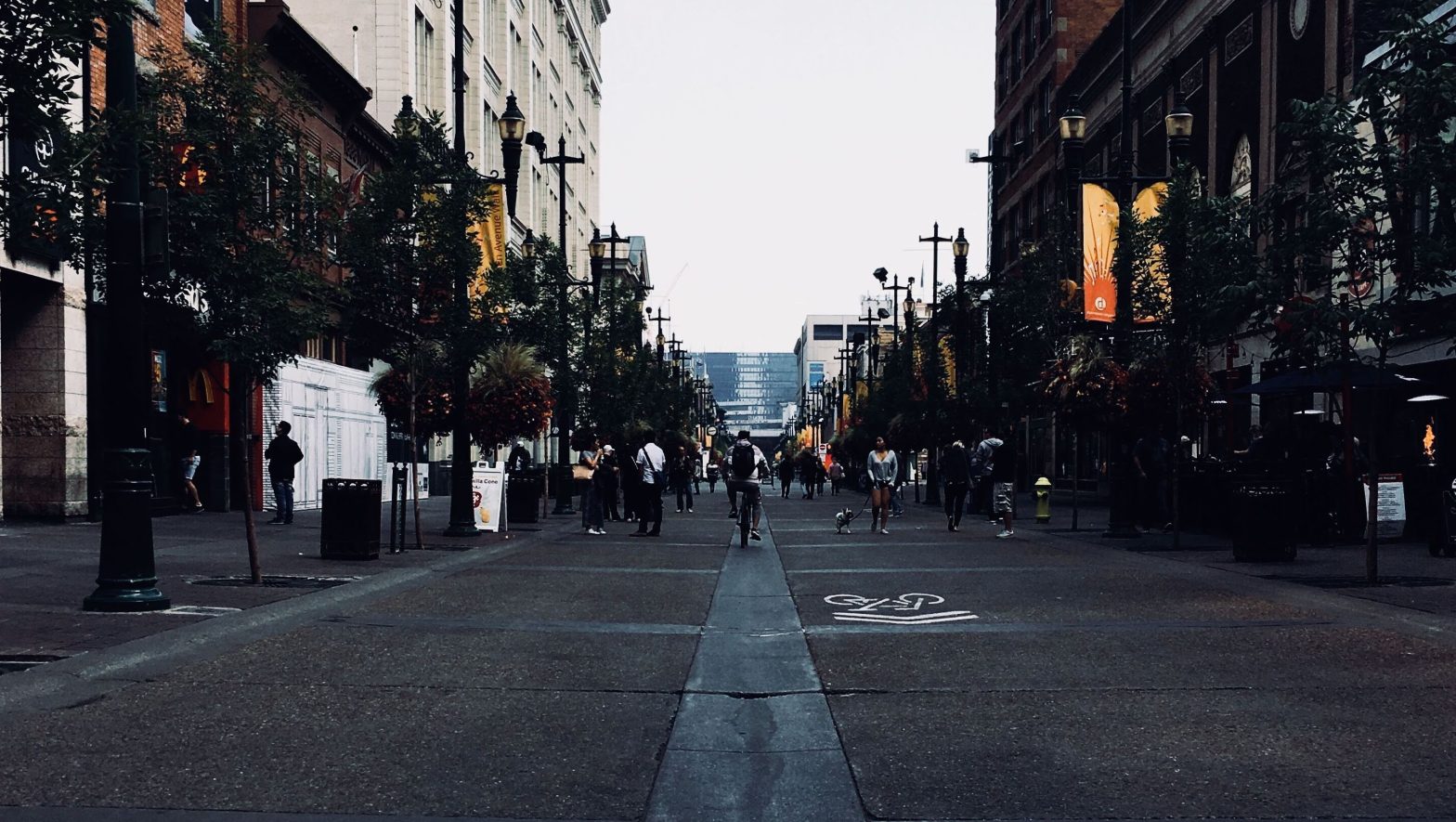
What does Calgary have to offer? What value does a tiny, fledgling city in the heart of Alberta bring to a prosperous Canadian nation and a bustling world stage? Many would answer this question with a rather dismissive ‘not much’ – that is if they are even able to point to Calgary on a map – and quite rightfully so. Generally, when one thinks of Calgary, they think not of its rich history and culture as they would of London, Paris, or Rome; neither do they envision its towering skyscrapers and bustling streets as they would of New York or Tokyo. Even within Canada, Calgary is often overshadowed by the likes of Toronto, Vancouver, and Montreal. To many outsiders, there is a certain urban romanticism missing from Calgary, as if it were nothing but a bland and greyscale industrial complex lacking culture, beauty, history, and life; and its place as a young, emerging city post-Industrial Revolution certainly does not help its cause. Yet, in assuming such things of Calgary, many often fail to see how beautiful and lively the city really is, how truly vibrant its extensive history and living culture are – if only they would just take a moment to look a little closer! Beneath all the snow and ice lies a city itching to be discovered, explored, and flung to the world, a city of life, love, and everything in between. And at the very heart of this fascinating metropolis is perhaps its most prized possession; the awe-inspiring Stephen Avenue Place along 8th Avenue SW in the city’s downtown.
Known for its iconic sandstone and granite buildings, its vibrant restaurants and independent stores, and the numerous modern art sculptures and monuments that line its streets, it is clear that Stephen Avenue makes good on its reputation as ‘the Heart of Calgary,’ for it is, itself, the quintessential embodiment of everything it means to be Calgarian and, like the vital human heart, is the core that keeps this city alive and teeming with passion. Its picturesque streets, always brimming with life, culture, and beauty, are shaped and set apart from the rest of Calgary in three main ways which tell three different stories; the story of its rich and vibrant history as told through its beautiful Beaux-Arts inspired architectural design, the story of its eccentric and energetic culture and its roots in its hundred-year long heritage, and the stories it tells of a people and a way of life, of friends and family, of memories, long tucked away, and of an amazing city waiting, just waiting, to throw itself out to the world. Stephen Avenue is the ultimate expression of everything Calgary, like how a painter or a writer crafts a story of his life into a work of pure beauty; an expression of its culture, its identity, its arts, its history, its people, and its place on the world stage. Finally, Stephen Avenue is an act of defiance, an act of resistance against those who claim Calgary to be none but a desolate, industrial wasteland or a small town of rowdy cowboys and farmers – yet still against those who carelessly lump Calgary together among the likes of Saskatoon, Winnipeg, or Edmonton – no more! At last, it is time for the story of our beloved city to be told, and where better place to begin than at its very heart?
History through Architecture.
Stephen Avenue; where classical architecture reminiscent of the Victorians meets the modernism of a Calgary paving the way forward.
What is perhaps most distinctive about Stephen Avenue, at least in the physical sense, is its exceptional architectural design. Its historic streets are lined with beautiful sandstone and granite buildings constructed according to Beaux-Arts and Victorian-inspired architectural design principles, which gives the avenue a certain classical feel reminiscent of such greats as the Roman Empire or the great British Empire. It is clear that the architects of Stephen Avenue took much inspiration from some of the most iconic European boulevards, specifically the Avenue des Champs-Élysées in Paris, where many elements of the Élysées’ detailed façades and linear street character can be clearly observed all over Stephen Avenue.
Additionally, the avenue draws heavy influence from the distinctive styles of late-nineteenth-century Québec, Montréal, and even Ottawa. Though not to the same extent as its Eastern Canadian brothers, Stephen Avenue boasts some of the most beautiful examples of ‘Victorian High Gothic’ and ‘Second Empire’ style architecture, characterized by its intriguing window, balcony, roof, and overhang designs, among many other things. That said, however, Stephen Avenue lacks some of the bright colours and red bricks that are traditionally seen in Gothic Revival architectural designs due to its use of local materials like sandstone and granite, which gives the avenue the classical ambience of the great European works while adding its own uniquely Calgarian spin.
This distinctive Calgarian style, however, was not born out of beauty or creativity but simply out of necessity. The Great Calgary Fire of 1886 ravaged through Stephen Avenue and destroyed many of its original old-west-esque wooden buildings, which in turn incentivized city planners to rethink some of their design principles and invest in rebuilding the city out of locally-available fire-resistant materials, which just so happened to be such materials as sandstone, limestone, and granite; materials that define the very character of Stephen Avenue to such an extent that it is nearly impossible to imagine what Stephen Avenue would be like without them. Is it not crazy to think that had it not been for a terrible fire burning our city to the ground, we might have missed out on such an important aspect of Calgary’s unique character?
In addition to its beautiful neo-gothic architectural design, however, what sets Stephen Avenue apart from the rest of Calgary is the way it juxtaposes the old and the new, and how it combines such wildly different and often incompatible architectural designs in such a way that they perfectly complement each other. Stephen Avenue is characterized just as much by its Beaux-Arts style architecture as it is by the many towering skyscrapers that line its streets or the numerous glass-and-steel modernist structures built atop or alongside historical buildings. Perhaps the most distinctive of these modernist structures are The Galleria Trees which line Stephen Avenue between 2nd and 3rd Street SW just outside the iconic Bankers’ Hall. These postmodern white structures, constructed out of welded steel and iron, were meant to echo the actual trees that were once planted along Stephen Avenue in earlier generations of the city. What is not widely known, however, is like the use of sandstone and granite, the Galleria Trees actually have a highly practical origin. They were initially constructed to help regulate and break up wind tunnels in the city’s downtown, which once posed a significant problem given the city’s rather harsh and sometimes violent weather. The trees (unlike some other structures in the city like the Blue Ring in the north end of the city; beautiful perhaps only for its sheer absurdity) actually contribute a lot to the atmosphere and character of Stephen Avenue and helps to give the avenue, and in turn, the city, its own unique sense of culture and personality which allows both the gothic and modernist styles that define the avenue to flourish and complement each other to showcase the true extent of their beauty.
Culture through History.
Not only is Stephen Avenue a marvel of architectural design and a living illustration of the city’s rich heritage and history; it is also a lively cultural and economic hub; the very lifeblood of the city as a whole. As Calgary’s prime entertainment and commercial district, Stephen Avenue hosts some of Calgary’s finest local restaurants, bars, coffee shops, shopping centres, theatres, landmarks, and trendy, independent shops selling anything one might think of; books, clothes, souvenirs, and everything in between. What is particularly notable about Stephen Avenue’s commercial scene, however, is that it is almost entirely comprised of small, local, independent businesses operating out of renovated or converted historical properties. Stephen Avenue boasts some of the highest occupancy rates in the city at over ninety per cent year after year, and in an era where due to a suffering economy many local Calgarian businesses have been drowned out by large American, Chinese, and international business ventures, it can be refreshing to see such a high concentration of local businesses in the core of downtown who continue to foster and preserve this valuable Calgarian identity. Stephen Avenue has a certain capacity to provide hundreds of new experiences and the creation of fond memories that many Calgarians hold dear to their heart simply because there is something for everybody on Stephen Avenue. From the charming Devonian Gardens to the romantic lights dangling across the lamposts of the streets, from the countless art sculptures and independent works to the street performers and local musicians, from the expressive Palace Theatre to the elegant Art Gallery of Calgary, from The Core to Bankers Hall to Stephen Avenue Place, and from the littlest of artisan shops to the finest delectable restaurants, Stephen Avenue is the ultimate expression of the city’s life. And with a major overhaul of Stephen Avenue coming throughout the new decade, who knows what new life and vibrancy the Heart of Calgary will bring?
Stephen Avenue’s place as Calgary’s cultural and economic hub, one so rich in such fervent history, life, and dynamism, is what earned it a designation by Parks Canada as a National Historic Site of Canada. The steady growth of Stephen Avenue is a brilliant illustration of Calgary’s development and expansion, and it tells a unique story of Western Canadian urban development, what with the Canadian Pacific Railway and how it almost singlehandedly laid the foundations for Calgary to become the regional and national powerhouse it has. (As a matter of fact, Stephen Avenue itself was actually named for George Stephen, the first president of the Canadian Pacific Railway.) Having been built near numerous railyards and a major train station, it is no wonder Stephen Avenue has exploded into the vibrant cultural hub and gathering place it is. Additionally, Stephen Avenue is a living example of how tremendous the impacts of commercial streets and the Canadian retail sector are on not only the economy but the Canadian urban experience as a whole. Finally, Stephen Avenue paints a beautiful picture of how such seemingly material and socially unimportant things as architecture, business, commerce, and landmarks can actually hold such significant sentimental value for many, so much so as to define an entire city’s identity and culture.
Stories through Culture.
What is perhaps the most impactful, and by far, the most important aspect of Stephen Avenue, however, is the way its living personality and culture fostered by its vibrant atmosphere and extensive heritage is able to create something beautiful in the hearts of Calgarians, something sentimentally meaningful and of high social importance.
The question of what makes Stephen Avenue such a central and defining part of our city goes far beyond its economic and cultural contributions. Stephen Avenue is beautiful not because the enormous amounts of money it brings into the city are beautiful, but because Calgarians are beautiful. Stephen Avenue holds absolutely no inherent meaning on its own – by this logic it is nothing but a collection of articulately placed stone and rocks. It holds meaning and beauty because Calgarians have given the stone and rocks there meaning and beauty; Calgarians feel a sort of sentimental and meaningful connection to Stephen Avenue as if it were a living being, – and it is possible to argue that, in the figurative sense, it is, in fact, a living being – and thus they see it to be their responsibility to maintain and preserve its streets and to give it a sense of culture and personality not seen in many other parts of the city. Calgarians attach certain fond memories and experiences to Stephen Avenue, and it is these memories that give the avenue its identity and its place as the Heart of Calgary. As a cultural hub, Stephen Avenue provides the opportunity for such memorable experiences for Calgarians and visitors from all walks and stages of life. Hidden within those beautiful buildings and streets are stories; stories of life; and these stories can vary from person to person. Maybe these stories tell of love, whether it be of a first date with the love of one’s life or the site of a newlywed couple’s beautiful wedding photos. Or maybe these stories tell of joy and friendship, whether it be the site of a memorable day of exploring the city with friends or a memorable night out with family members. It is these stories that give Stephen Avenue the charm and fondness as one would expect of the Heart of Calgary.
Personally, Stephen Avenue holds a great sentimental meaning to me simply because I associate it with some of my dearest memories. Some of the most monumental, transformative, and memorable moments of my life have occurred on and around Stephen Avenue. I quite fondly remember strolling through Stephen Avenue and exploring all the little shops and businesses with my family while visiting Canada for the first time. Stephen Avenue was the one place that I remembered so vividly and always dreamed of in my head whenever we were away from it, and when my family broke the news that we were moving to Canada, Stephen Avenue was the very first place I envisioned. A few years later, I found myself leading a few family friends along the streets of Stephen Avenue, and they too ended up becoming apart of this greatest country on Earth. Stephen Avenue was the site of my first date, the place where some of my best friends and I got to explore the city on our own for the first time, the place where I took my graduation photos, and the place where I officially swore myself in as a Canadian citizen.
 line of best fit